
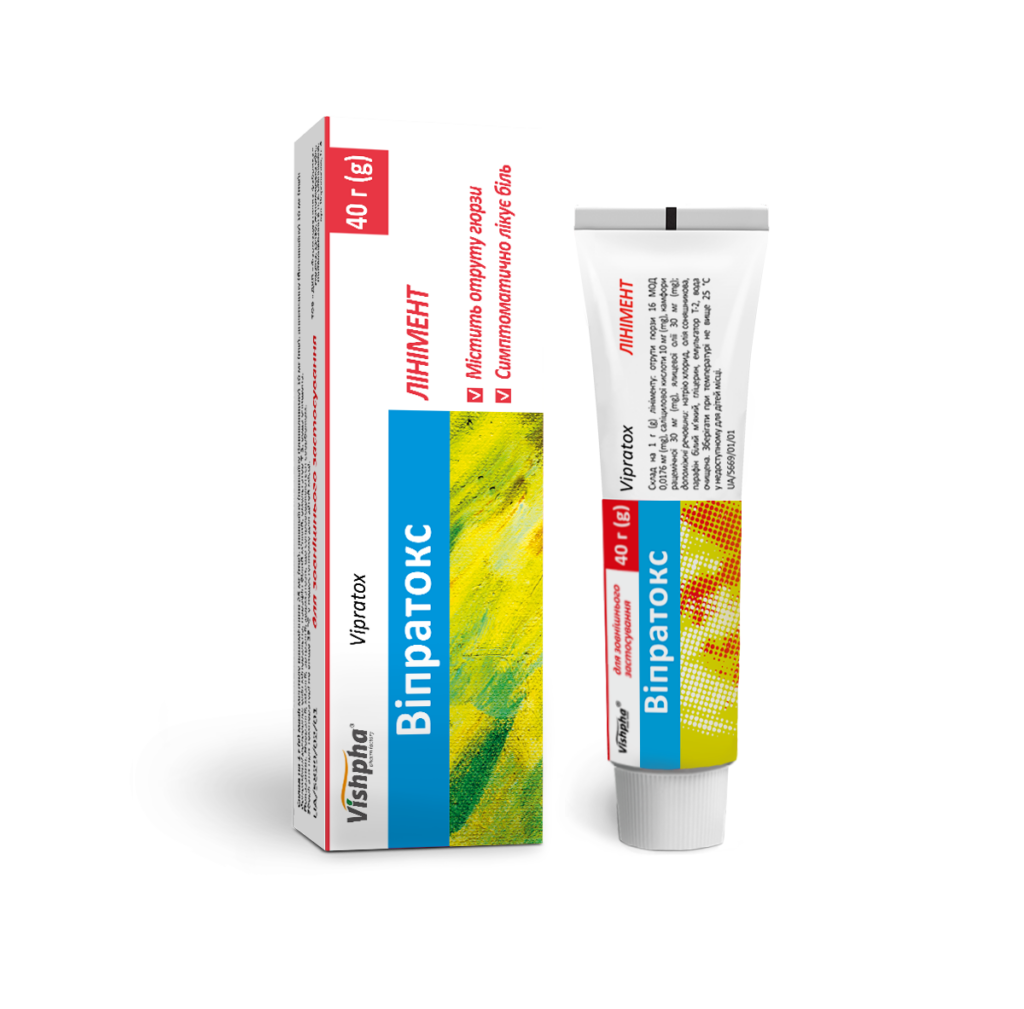
Vipratox
Liniment containing viper venom for the relief of pain and muscle stiffness
Age limits:
From 2 months
Vacation сategory:
No prescription
Vipratox is a medicinal product based on snake venom (viper venom), used to relieve pain and muscle stiffness following strenuous physical activity, injuries, blows and strains that may occur as a result of sporting activities or everyday activities.
The drug is taken:
Symptomatic treatment of pain associated with rheumatism, neuralgia, sciatica, lumbago, radiculitis, myalgia and arthralgia.
Active substances
1 g of liniment contains viper venom 16 MOD 0.0176 mg, salicylic acid 10 mg, racemic camphor 30 mg, fir oil 30 mg;
Other substances
sodium chloride, sunflower oil, white soft paraffin, glycerine, emulsifier T-2, purified water.
active ingredients: gyurza venom 16 MOD, salicylic acid, racemic camphor, fir oil;
1 g of liniment contains 0.0176 mg of gyurza poison 16 MOD, 10 mg of salicylic acid, 30 mg of racemic camphor, 30 mg of fir oil;
excipients: sodium chloride, sunflower oil , white soft paraffin, glycerin, emulsifier T-2, purified water .
Liniment.
Main physicochemical properties: white liniment with a characteristic smell of camphor and fir oil.
Drugs used topically for joint and muscle pain .
ATX code M 02 A X 10.
Pharmacodynamics.
The main active ingredient of Vipratox is the poison of the gyurza ( Venenum Macrovipera e lebetina ) containing phospholipase, phosphodiesterase, hyaluronidase and other active substances.
The effect of the drug is due to the toxins contained in the gyurza venom.
Postsynaptic neurotoxins that specifically block H-cholinergic receptors of the subsynaptic membrane of skeletal muscles and some parts of the central nervous system.
Presynaptic neurotoxins, which act on presynaptic nerve endings and contribute to increased release of mediators.
Membrane-active neurotoxins (cardio-polypeptides and cytotoxins), which act actively on cell membranes, including causing their depolarization.
Along with the specific action, which directly depends on the components of the poison, the therapeutic effect of the drug is associated with reflex reactions that occur due to irritation of skin receptors, with the effect of biogenic substances formed during the local action of the drug on tissues, with the effect on the immunological reactions of the body, as well as with the stimulation of the “pituitary-adrenal” system. When applied topically, gyurza venom has an irritating and analgesic effect.
Salicylic acid, when applied externally, has an antiseptic, irritating, distracting, and keratolytic effect, promoting better penetration of active ingredients.
fir oil easily penetrates the epidermis, irritating the sensory nerve endings of both superficial vessels and vessels of deeper tissues.
Thanks to camphor, the drug exhibits local irritating, analgesic and anti-inflammatory effects and, by stimulating sensitive nerve endings of the skin, improves tissue trophism.
Pharmacokinetics.
Not studied.
Symptomatic treatment of pain in rheumatism, neuralgia, sciatica, lumbago, radiculitis, myalgia, arthralgia.
Hypersensitivity to the components of the drug. Bronchial asthma, whooping cough, tendency to bronchospasm, tendency to seizures, acute pulmonary tuberculosis, cerebral and coronary circulation disorders, tendency to angiospasms, severe renal and hepatic dysfunction, pustular skin diseases, damage to the integrity of the skin at the site of drug application, fever, general fatigue.
Do not apply to skin with signs of an allergic reaction.
Avoid contact with eyes, open wounds and mucous membranes. In case of accidental contact with eyes or mucous membranes, rinse thoroughly with plenty of running water.
Use with caution in elderly patients.
Not studied. Although adequate controlled interaction trials have not been conducted, it is not excluded that excessive use of topical salicylates may increase the effect of coumarin anticoagulants and antiplatelet agents. Caution should be exercised in patients receiving coumarin anticoagulants and antiplatelet agents, including acetylsalicylic acid.
Contraindicated during pregnancy or breastfeeding.
The drug does not affect the reaction speed when driving or working with other mechanisms.
To avoid side effects, it is necessary to apply a small amount of liniment to the skin in advance to determine individual sensitivity to the drug.
Depending on the size of the painful area, apply the liniment in small portions of 5-10 g and rub it thoroughly into the skin 1-2 times a day until the pain disappears.
The course of treatment is determined by the doctor depending on the severity of the disease and the effectiveness of the treatment.
There is no experience with use in children, therefore use in this category of patients is not recommended.
At Accidental contact with mucous membranes causes severe irritation. Allergic reactions (itching, dermatitis, peeling of the skin) are possible. It is recommended to stop using the liniment and wash off any remaining residue from the skin. If necessary, symptomatic treatment is indicated.
Incorrect use.
Accidental ingestion of the ointment may cause gastrointestinal symptoms such as vomiting and diarrhea. Treatment is symptomatic.
Accidental ingestion of large amounts of ointment may cause symptoms of acute poisoning, such as nausea, vomiting, abdominal pain, headache, dizziness, feeling hot/flushing, convulsions, respiratory depression and coma.
Treatment of patients with severe gastrointestinal or neurological symptoms of poisoning is symptomatic. Vomiting should not be induced.
Local allergic reactions are possible (including itching, burning, rash, dryness, peeling, irritation, contact dermatitis, urticaria), increased body temperature.
3 years.
Do not use the drug after the expiration date indicated on the package.
Store at a temperature not exceeding 25 ºС in a place inaccessible to children.
40 g in a tube in a pack.
Without a prescription.
